

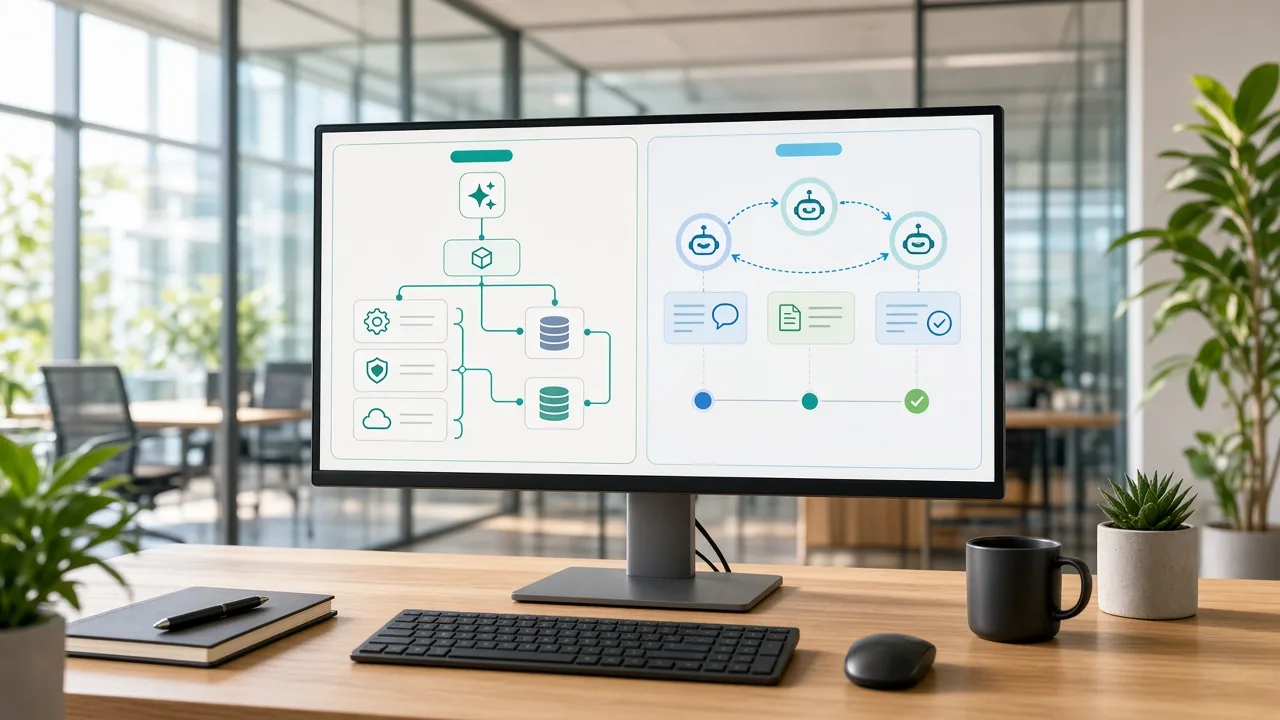
Key Takeaways
- MCP and A2A solve different integration problems: MCP connects AI applications with tools and data, while A2A enables communication and collaboration between independent agents.
- MCP is useful for enterprise tool and data access: It can expose approved tools, resources, and prompts through MCP servers.
- A2A is designed for agent collaboration: Agent Cards, Tasks, Messages, and Artifacts support agent discovery, delegation, and longer-running workflows.
- Enterprises do not necessarily have to choose one: MCP and A2A can work together, with MCP handling tool and data connectivity while A2A handles collaboration between agents.
- Security and governance should come first: identity, authorization, data protection, monitoring, and agent trust need to be addressed before scaling an enterprise agent ecosystem.
MCP vs A2A Protocol: Key Differences for Enterprise AI Agent Integration
Enterprise AI systems increasingly need to connect models and agents with business applications, data sources, APIs, and other AI agents. As these systems become more distributed, organizations need standardized ways to manage these interactions rather than building every integration independently.
The Model Context Protocol (MCP) is designed to standardize how AI applications connect with external tools, resources, and prompts. Agent2Agent (A2A) is designed to enable communication and collaboration between independent AI agents, including agents built with different frameworks or by different vendors.
This means MCP and A2A generally address different layers of an enterprise AI architecture rather than serving as direct alternatives. An enterprise may use MCP to give an individual agent access to tools and data while using A2A to allow that agent to communicate with other specialized agents. The official A2A documentation explicitly describes the two protocols as complementary.
This guide compares MCP vs A2A Protocol, explains how each works, examines their architecture and security considerations, and discusses how enterprises can determine where each protocol fits within their broader AI integration strategy.
MCP Protocol Market Statistics
The model context protocol security market size was valued at USD 134.24 million in 2025 and estimated to grow from USD 169.73 million in 2026 to reach USD 624.46 million by 2031, at a CAGR of 29.76% during the forecast period (2026-2031).
The U.S. Model Context Protocol (MCP) market is projected to grow from $0.45 billion in 2025 to $10.27 billion by 2035, while Europe is expected to expand from $0.24 billion to $5.16 billion by 2035.
Understanding the Model Context Protocol (MCP) and How It Works
The Model Context Protocol (MCP) is an open standard for connecting AI applications with the systems where business data and tools are available. An MCP server can expose capabilities that an AI application can use without requiring a custom integration for every individual application.
MCP Tools
Tools are executable functions that allow an AI model to perform actions or retrieve information. Examples can include querying a database, calling an API, creating a record, or interacting with another business system.
MCP Resources
Resources provide structured information or content that an AI application can use as context. They can represent documents, files, database information, or other application-managed data.
MCP Prompts
Prompts are reusable templates or instructions that can guide how an AI application interacts with a particular workflow or capability. They can also incorporate relevant resources when supported by the implementation.
MCP Client and Server Model
In a typical MCP architecture, an AI application acts as the host or client, while MCP servers expose specific tools, resources, and prompts. This separates the AI application's reasoning from the systems that provide capabilities or data.
Why Enterprises Use MCP
For enterprises, MCP can provide a standardized integration layer between AI applications and internal or external systems. Instead of building separate interfaces for every AI application, organizations can expose reusable capabilities through MCP-compatible servers.
MCP and Enterprise Security
MCP implementations can include authentication, identity, roles, access controls, and other security mechanisms. The current MCP specification has also introduced stronger authorization and enterprise-oriented capabilities as the protocol evolves.
Enterprises evaluating software development technologies for AI integration can therefore consider MCP when the primary requirement is giving AI applications controlled access to business tools, resources, and workflows.
Understanding the Agent2Agent (A2A) Protocol and How It Works
The Agent2Agent (A2A) Protocol is an open standard designed to allow independent AI agents to communicate and collaborate, even when they are built with different frameworks, programming languages, or vendors. Unlike MCP, which primarily connects an AI application with tools and data, A2A focuses on communication between agents.
Agent Cards
An A2A Agent Card describes an agent's identity, endpoint, capabilities, skills, and authentication requirements. Other agents or clients can use this information to discover whether the agent is appropriate for a particular task.
Messages
Messages allow agents to exchange instructions, questions, context, clarification, or status information. A2A supports different types of content, including text, files, and structured data.
Tasks
A task represents a stateful unit of work. It can remain active while an agent processes a complex request, making A2A suitable for workflows that require multiple steps or longer execution times.
Artifacts
Artifacts represent concrete outputs produced during a task, such as documents, structured data, or other generated content. Separating artifacts from ordinary messages provides a clearer way to manage task results.
Agent Discovery
Agents can discover one another through Agent Cards that publish capabilities and connection information. This allows organizations to connect specialized agents without requiring every agent to understand the internal implementation of another agent.
Asynchronous Collaboration
A2A supports request/response interactions as well as streaming and push notifications for longer-running tasks. This allows agents to continue work and provide status updates without requiring a single synchronous request to remain open.
Framework and Vendor Interoperability
A key purpose of A2A is interoperability between independent agent systems. Agents can collaborate through a common protocol without needing access to one another's internal memory, tools, or reasoning processes.
For enterprises exploring AI integration services, A2A can therefore be useful when multiple specialized agents need to coordinate across departments, applications, frameworks, or technology vendors.
MCP vs A2A: Key Differences in AI Agent Communication and Integration
MCP and A2A address different interoperability problems within agentic AI systems. MCP is primarily concerned with connecting AI applications to tools and contextual resources, while A2A focuses on communication and collaboration between independent agents. The two protocols can therefore be used together rather than treated as mutually exclusive choices.
| Comparison Area | MCP | A2A |
|---|---|---|
| Primary Purpose | Connects AI applications with tools, resources, and prompts | Enables communication and collaboration between AI agents |
| Main Interaction | Agent/application ↔ tools and data | Agent ↔ agent |
| Core Components | Tools, resources, prompts, MCP servers and clients | Agent cards, messages, tasks, parts, and artifacts |
| Discovery | Discovers available capabilities exposed by MCP servers | Uses Agent Cards to discover agent capabilities and endpoints |
| Task Model | Supports tool and resource interactions; current MCP versions also include task-related capabilities | Uses stateful tasks as a central concept for long-running or multi-step work |
| Typical Use Case | Giving an agent access to databases, APIs, files, or business tools | Delegating work between specialized agents |
| Agent Transparency | Focuses on exposing capabilities to an AI application | Allows agents to collaborate without exposing their internal reasoning, memory, or tools |
| Enterprise Role | Vertical integration with enterprise systems | Horizontal coordination across independent agents |
| Can They Work Together? | Yes | Yes |
MCP Is Primarily for Tool and Data Connectivity
An enterprise can use MCP to expose approved business capabilities such as databases, APIs, document repositories, or application functions to an AI application.
A2A Is Primarily for Agent Collaboration
A2A allows one agent to discover another agent, send it a task, receive progress updates, and obtain the resulting artifact without needing to know the other agent's internal implementation.
MCP and A2A Can Form a Combined Architecture
For example, a customer-service agent could use MCP to access a CRM and order-management system while using A2A to delegate a specialized refund or logistics task to another agent.
How MCP and A2A Work Together to Enable Enterprise AI Integration
MCP and A2A can complement each other when an enterprise operates multiple AI agents that also need access to business tools and data. MCP can provide an agent with controlled access to tools and resources, while A2A can allow that agent to collaborate with other specialized agents.
A Combined Architecture
An enterprise AI system might contain a customer-service agent, finance agent, HR agent, logistics agent, and analytics agent. Each agent can use MCP connections to access the systems relevant to its responsibilities.
Example: Customer Order Issue
A customer-service agent may receive a request about a delayed order. It can use MCP to access the CRM, order database, and shipping system.
If the issue requires specialized logistics analysis, the customer-service agent can use A2A to delegate that task to a logistics agent. The logistics agent can then use its own MCP connections to access approved logistics tools and data.
Separation of Responsibilities
This architecture allows each agent to maintain clearly defined responsibilities and permissions. An agent does not necessarily need direct access to every enterprise system simply because another agent can perform the required task.
Reusable Integrations
MCP servers can expose reusable business capabilities that multiple AI applications or agents can access under appropriate authorization policies. This can reduce the need to build separate tool integrations for every agent.
Agent Interoperability
A2A can connect agents built by different teams or vendors as long as they support the protocol. This can be useful when enterprises gradually expand their agent ecosystem instead of deploying a single centralized agent.
Governance Benefits
Separating tool access from agent-to-agent communication can also make governance easier. Enterprises can define which agents can communicate, which tools each agent can access, and which actions require additional authorization.
When the Combined Model Makes Sense
Using both protocols can be useful when an organisation has multiple specialized agents and a broad set of enterprise systems. Businesses should still evaluate security, identity, monitoring, data governance, and operational complexity before connecting additional agents or tools.
Organizations planning AI development services can use this layered approach to separate tool integration from agent collaboration while building a more modular enterprise AI architecture.
MCP Architecture: Understanding Agents, Tools, Resources, and Prompts
MCP uses a client-server architecture that separates an AI application from the external tools and information it needs to perform tasks. In the current MCP specification, servers can expose tools, resources, and prompts, while AI applications act as hosts that connect to those servers.
MCP Host and Client
The MCP host is the AI application that provides the environment in which the model operates. It can create MCP client connections to one or more MCP servers and make their approved capabilities available to the model.
MCP Servers
An MCP server exposes specific capabilities to connected clients. These capabilities can include executable tools, accessible resources, and reusable prompt templates.
Tools
Tools allow the AI application to perform actions or retrieve information through defined functions. Examples include searching a database, calling an internal API, creating a record, or interacting with a business system.
Resources
Resources provide information that an AI application can use as context. They can represent documents, files, database content, or other application-managed information.
Prompts
Prompts provide reusable templates or structured instructions for particular workflows. Enterprises can use them to standardize how AI applications interact with specific capabilities.
Enterprise Integration Layer
An enterprise can deploy different MCP servers for different business systems. For example, one server might expose CRM tools, another could provide document resources, and another could expose approved finance operations.
Transport and Deployment
Current MCP implementations support transports including Streamable HTTP and standard input/output, with the latest specification also emphasizing a stateless protocol core for scalable remote deployments.
Security and Authorization
MCP deployments should apply authentication, authorization, access controls, and appropriate policy enforcement around exposed capabilities. The 2026 MCP specification has also strengthened its authorization model and enterprise-oriented security controls.
For organizations evaluating software development technologies, this architecture can provide a standardized way to connect AI applications with enterprise tools and data while keeping those integrations separated into controlled services.
Security, Identity, and Governance Considerations for AI Systems
Connecting AI agents to enterprise systems introduces security risks because protocols can enable access to business data, tools, applications, and other agents. MCP and A2A therefore need to be implemented within the organization's broader identity, authorization, monitoring, and governance architecture.
| Security Area | MCP Consideration | A2A Consideration |
|---|---|---|
| Identity | Authenticate the AI application and MCP server connection | Authenticate agents and their communication endpoints |
| Authorization | Control access to individual tools and resources | Control which agents can communicate and perform delegated tasks |
| Data Protection | Restrict access to sensitive enterprise resources | Control information shared between agents |
| Credential Management | Secure tokens and service credentials | Secure authentication credentials for agent interactions |
| Monitoring | Log tool calls, resource access, and authorization events | Monitor agent requests, tasks, messages, and outcomes |
| Governance | Define which applications can use specific capabilities | Define trusted agents, permitted interactions, and escalation rules |
Identity and Authentication
Enterprises should establish reliable identities for users, applications, MCP servers, and agents. Authentication requirements should be applied before protected tools, resources, or agent endpoints are made available.
Authorization and Least Privilege
Authentication alone does not determine what an AI system is allowed to do. MCP tools and resources should have clearly defined permissions, while A2A communication should be restricted to approved agents and supported task types.
Data Protection
Sensitive customer, financial, employee, or proprietary information should only be shared when necessary for the task. Data access policies should also apply when one agent delegates work to another agent.
Credential and Secret Management
API keys, access tokens, and service credentials should be stored through secure secret-management mechanisms rather than being exposed unnecessarily within prompts, agent messages, or application code.
Monitoring and Auditability
Organizations should maintain appropriate logs for tool calls, resource access, agent requests, task execution, authorization decisions, and security events. This can help with troubleshooting, investigations, and compliance requirements.
Agent Trust and Discovery
Enterprises should establish rules for which agents are trusted to communicate with one another. A2A's Agent Card model provides information about an agent's capabilities and authentication requirements, but organizations still need their own trust and authorization policies.
Governance Across the AI Ecosystem
As organizations add more agents, tools, models, and integrations, governance becomes increasingly important. Businesses may use IT consulting services to define identity models, integration standards, access policies, monitoring practices, and governance processes across their AI ecosystem.
Security Should Span Both Protocols
MCP and A2A solve different integration problems, but security controls should work together. An enterprise should know which user initiated a task, which agent handled it, which tools or other agents were contacted, what data was accessed, and what actions were ultimately performed.
When Enterprises Should Use MCP for AI Integration
MCP is generally useful when an AI application needs standardized access to business tools, APIs, databases, documents, or other external resources. Its current specification is designed around exposing tools, resources, and prompts through MCP servers.
Connecting Agents to Enterprise Systems
MCP can be suitable when an AI application needs controlled access to systems such as CRM platforms, databases, document repositories, project-management tools, or internal APIs.
Standardizing Tool Integrations
Instead of creating a separate custom integration for every AI application, businesses can expose reusable capabilities through MCP-compatible servers.
Working With Business Data
MCP can help AI applications access approved resources such as documents, structured data, knowledge bases, or other enterprise information.
Supporting Multiple AI Applications
An organization can expose shared MCP capabilities to multiple compatible AI applications, subject to its authorization and governance policies.
Building Tool-Centric Agents
MCP is particularly relevant when the main requirement is enabling one agent or AI application to use multiple tools to complete a task rather than coordinating several independent agents.
Enterprise-Scale Deployments
The July 2026 MCP specification introduced a stateless protocol core along with updated authorization and scalability capabilities, making the protocol more suitable for remote and production deployments.
When MCP Alone May Be Enough
If an enterprise has a single agent that needs access to internal databases, APIs, files, and business applications, MCP may provide the required integration layer without introducing an additional agent-to-agent protocol.
When Should Enterprises Use A2A for AI Agent Communication?
A2A is designed for communication and collaboration between independent AI agents. It becomes useful when an enterprise has multiple specialized agents that need to discover capabilities, delegate work, exchange information, and coordinate longer-running tasks.
Coordinating Specialized Agents
An enterprise may have separate agents for finance, customer service, HR, logistics, analytics, or procurement. A2A can allow these agents to collaborate without requiring each one to understand the other's internal implementation.
Delegating Complex Tasks
A2A is useful when one agent needs to hand off part of a larger task to another specialized agent. The protocol's task model supports stateful work and allows progress to be tracked across multiple interactions.
Connecting Agents From Different Vendors
Enterprises may use agents built with different frameworks, languages, or technology platforms. A2A is specifically designed to support interoperability across these boundaries.
Supporting Long-Running Workflows
Some enterprise tasks may take minutes, hours, or longer and may require multiple steps or human intervention. A2A supports asynchronous task execution, streaming updates, and push notifications for these scenarios.
Building Multi-Agent Systems
A2A can provide the communication layer for systems where multiple autonomous agents work together toward a shared business objective rather than relying on a single central agent.
Enabling Agent Discovery
Agent Cards allow agents to publish information about their identity, capabilities, skills, endpoints, and authentication requirements. This can help enterprise systems determine which agent is suitable for a particular task.
When A2A Alone May Not Be Enough
A2A handles communication between agents, but those agents may still need access to databases, APIs, files, or business applications. In such cases, an agent can use MCP for tool and data connectivity while using A2A for collaboration with other agents.
For enterprises working with an AI agent development company, A2A is therefore most relevant when the main requirement is agent-to-agent collaboration, delegation, and interoperability rather than direct access to enterprise tools.
MCP vs A2A for Common Enterprise AI Use Cases and Applications
The right protocol depends on what an enterprise needs its AI system to connect to. MCP is primarily suited to tool and data integration, while A2A is designed for communication and collaboration between agents.
| Enterprise Use Case | More Relevant Protocol | Why |
|---|---|---|
| CRM data access | MCP | Connects an AI application with CRM tools and resources |
| Database queries | MCP | Provides controlled access to approved database capabilities |
| Document retrieval | MCP | Connects AI applications with document and knowledge resources |
| Customer-service agent calling business tools | MCP | Enables access to CRM, orders, tickets, and other systems |
| Finance agent delegating work to another agent | A2A | Supports agent-to-agent task delegation |
| HR agent collaborating with payroll agent | A2A | Enables communication between specialized agents |
| Multi-vendor agent ecosystem | A2A | Supports interoperability between independent agents |
| Long-running delegated workflows | A2A | Provides stateful tasks and asynchronous interaction |
| Multi-agent system accessing enterprise tools | MCP + A2A | MCP handles tools/data, while A2A handles agent collaboration |
Implementation Challenges and Key Technology Considerations for AI Systems
Implementing MCP and A2A in an enterprise environment requires more than adopting the protocols themselves. Businesses need to consider existing systems, identity management, security, monitoring, data governance, and the technical capabilities of their AI platform.
Legacy System Integration
Existing enterprise applications may not expose modern APIs or standardized interfaces. Organizations may need integration layers or adapters before AI agents can safely interact with them.
Identity and Access Management
AI applications and agents need clearly defined identities and permissions. Enterprises should determine which users, agents, tools, and resources can interact with one another.
Security and Governance
Adding more agents and integrations increases the number of connections that need to be secured and monitored. Authentication, authorization, audit logging, data protection, and policy enforcement should be considered from the beginning.
Protocol and Technology Maturity
MCP and A2A continue to evolve. Enterprises should monitor specification updates, implementation compatibility, security recommendations, and supported features before committing to a long-term architecture.
Monitoring and Observability
Organizations need visibility into tool calls, agent communication, task execution, errors, authorization decisions, and system performance. Without sufficient monitoring, diagnosing problems across distributed agent systems can become difficult.
Data Governance
Businesses should establish rules for what data agents can access, what information can be shared between agents, and how long agent-generated data or task records should be retained.
Internal Technical Expertise
Implementing agent protocols may require knowledge of APIs, distributed systems, cloud infrastructure, identity management, AI orchestration, and security.
Organizations may use software development technologies and established software development process practices to manage these integrations systematically.
Building an Enterprise AI Integration Strategy for Scalable AI Systems
Enterprises should select an AI integration approach based on how their agents interact with business systems and with one another. MCP and A2A solve different interoperability requirements, so the right architecture may involve one protocol or a combination of both.
Start With the Business Workflow
First, identify what the AI system needs to accomplish. Determine whether the workflow mainly requires access to enterprise data and tools, collaboration between specialized agents, or both.
Map Systems, Tools, and Agents
Create a clear inventory of the systems involved, including databases, APIs, documents, SaaS applications, internal platforms, and existing AI agents. This helps identify where MCP or A2A can provide value.
Use MCP for Tool and Data Access
When an agent primarily needs controlled access to business applications, files, databases, APIs, or other resources, MCP can provide the integration layer between the AI application and those capabilities.
Use A2A for Agent Collaboration
When multiple specialized agents need to communicate, delegate tasks, exchange information, or manage longer-running workflows, A2A can provide the agent-to-agent communication layer.
Combine MCP and A2A When Necessary
A larger enterprise architecture may use both protocols. For example, a central business agent can use A2A to delegate work to a finance agent, while the finance agent uses MCP to access approved accounting systems and financial data.
Establish Governance Before Scaling
Define authentication, authorization, agent trust, tool permissions, data-sharing policies, logging, monitoring, and incident-response procedures before connecting large numbers of agents and enterprise systems.
Build in Phases
Enterprises can begin with a limited number of tools or agents, validate security and operational requirements, and gradually expand the ecosystem.
Measure Operational Value
Track factors such as automation coverage, task-completion rates, response times, integration reliability, human-approval frequency, operational costs, and security events. These measurements can help determine whether the architecture is delivering the intended business value.
Conclusion
MCP and A2A should not be viewed simply as competing protocols. They address different layers of enterprise AI integration: MCP provides a standardized way for AI applications to access tools and resources, while A2A provides a communication layer for independent agents to discover capabilities, delegate tasks, and collaborate.
For an enterprise with a single or small number of agents that mainly need access to business applications and data, MCP may provide the required integration layer. Organizations building multi-agent environments may also benefit from A2A when specialized agents need to collaborate across teams, frameworks, or vendors.
In more complex enterprise architectures, using both protocols can provide a modular approach: agents can use MCP to interact with approved enterprise tools while using A2A to coordinate work with other agents. The right implementation should ultimately be based on business workflows, security requirements, existing systems, and the organization's long-term AI strategy.
Frequently Asked Questions
What is the difference between MCP and A2A?
MCP is designed to connect AI applications with tools, resources, and external systems, while A2A is designed to enable communication and collaboration between independent AI agents.
Is MCP a replacement for A2A?
No. The two protocols address different requirements and can be used together. MCP can provide tool and data access, while A2A can support communication between agents.
When should an enterprise use MCP?
MCP can be useful when an AI application needs controlled access to databases, APIs, documents, business applications, or other external tools.
When should an enterprise use A2A?
A2A is useful when multiple specialized agents need to discover one another, delegate tasks, exchange information, or collaborate on longer-running workflows.
Can MCP and A2A work together?
Yes. An enterprise can use A2A for agent-to-agent communication while individual agents use MCP to access their approved tools and business systems.
Is MCP suitable for enterprise applications?
MCP can be used in enterprise environments, but organizations still need to implement appropriate authentication, authorization, monitoring, data protection, and governance controls around their MCP deployments.
What security considerations apply to MCP and A2A?
Enterprises should consider identity management, least-privilege access, credential protection, data governance, agent trust, authorization, monitoring, audit logging, and secure handling of information exchanged between systems.
How should an enterprise choose between MCP and A2A?
The decision should start with the integration requirement. For AI-to-tool and AI-to-data connectivity, MCP is relevant; for agent-to-agent collaboration, A2A is relevant. Complex environments may use both.